Optical Strong Line Ratios Cannot Distinguish Between Stellar Populations and Accreting Black Holes at High Ionization Parameters and Low Metallicities
Dec 1, 2025·,,,,,,,,,,,,,,, ,,,,,,,,,,·
0 min read
Nikko J. Cleri
Grace M. Olivier
Bren E. Backhaus
Joel Leja
Casey Papovich
Jonathan R. Trump
Pablo Arrabal Haro
Véronique Buat
Denis Burgarella
Emilie Burnham
Antonello Calabrò
Jonathan H. Cohn
Justin W. Cole
Kelcey Davis
Mark Dickinson
Steven L. Finkelstein
Ray Garner
Michaela Hirschmann
Weida Hu
Taylor A. Hutchison
Dale D. Kocevski
Anton M. Koekemoer
Rebecca L. Larson
Zach J. Lewis
Michael V. Maseda
Lise-Marie Seillé
Raymond C. Simons
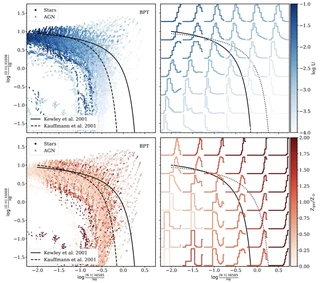 Figure 4 of Cleri et al. (2025)
Abstract
High-redshift observations from JWST indicate that optical strong line ratios do not carry the same constraining power as they do at low redshifts. Critically, this prevents a differentiation between stellar and black hole accretion-driven ionization, thereby obscuring both active galactic nuclei (AGN) demographics and star formation rates. To investigate this, we compute a large suite of photoionization models with Cloudy powered by stellar populations and accreting black holes over a large grid of ages, metallicities, initial mass functions, binarities, ionization parameters, densities, and black hole masses. We use these models to test three rest-frame optical diagnostics designed to separate ionizing sources at low redshifts: the [N II]-BPT, VO87, and OHNO diagrams. We show that these diagnostics are strongly driven by the ionization parameter (log U) and the gas-phase metallicity (Zgas), often more so than the ionizing spectrum itself; there is significant overlap between stellar population and accreting black hole models at high log U and low Zgas. The OHNO diagram is especially contaminated in the AGN region by stellar models with high log U and low Zgas, consistent with high-redshift observations. We show that the [N II]-BPT, VO87, or OHNO diagrams are most sensitive to the shape of the <54 eV ionizing continuum, an energy regime in which stellar populations and black hole accretion disk models can be highly degenerate. Finally, we discuss the potential for emission lines that trace the >54 eV ionizing continuum to differentiate between ionizing sources more effectively than the [N II]-BPT, VO87, or OHNO diagrams alone.
Type
Publication
The Astrophysical Journal, 994(2), 146-169
Status
Peer-reviewed
Open access
License
CC-BY-4.0

Authors
Ray Garner
(he/him)
TAMU Astronomy Postdoctoral Researcher
I’m a scientist, Star Wars fan, and amateur photographer raised in Georgia. My research interests include galaxy evolution, star formation, and nebular diagnostics.