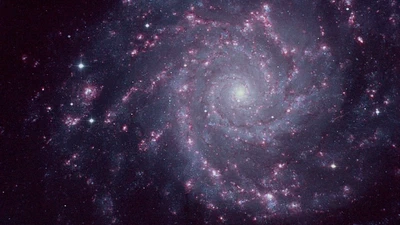
Resolved HII Regions with SIGNALS
Nebular emission lines are some of our most powerful tools for studying galaxies. From a handful of bright lines, we routinely estimate properties of star-forming regions (and …

Nebular emission lines are some of our most powerful tools for studying galaxies. From a handful of bright lines, we routinely estimate properties of star-forming regions (and …
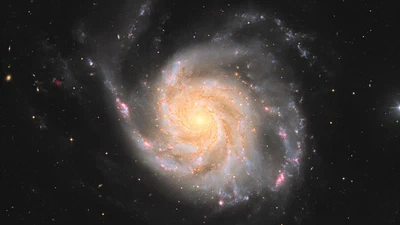
I have focused on the M101 Group since graduate school. Because it is only a few megaparsecs away, this small, isolated galaxy group gives us a detailed look at how spiral galaxies …
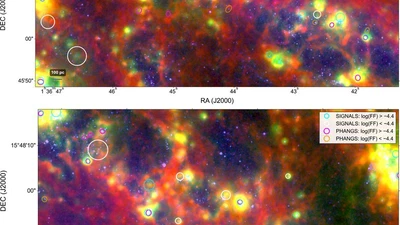
*Aims.* Understanding the internal structure of H II regions is fundamental to constraining star-formation processes in galaxies. We investigate how the *filling factor* (FF) …
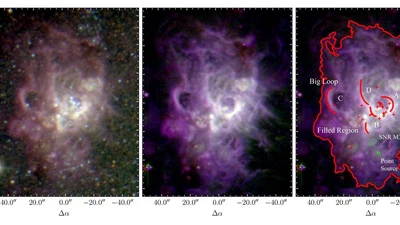
Observing giant H II regions at fine spatial scales uncovers detailed structures and reveals variations in ionization, abundance, and dynamical properties of ionized gas and the …
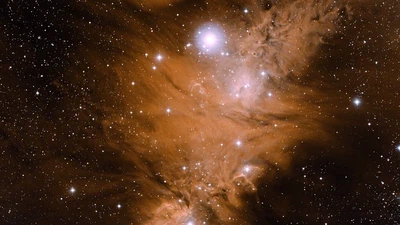
A 5-minute oral presentation delivered to the American Astronomical Society. This covers a recent completed paper on the spatially resolved data of NGC 604 as part of the SIGNALS …
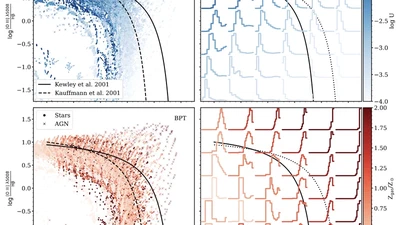
High-redshift observations from JWST indicate that optical strong line ratios do not carry the same constraining power as they do at low redshifts. Critically, this prevents a …
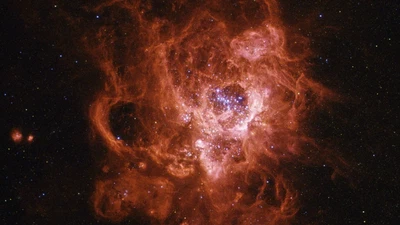
A poster presentation about my work investigating the spatially-resolved properties of NGC 604.
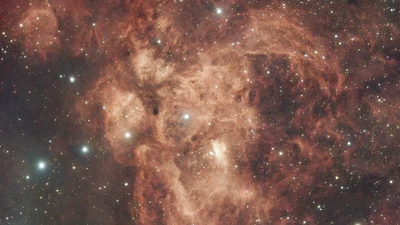
This talk was given as part of a weekly lunch talk for the undergraduates in the Aggie Scholarships for Technology Advancements in Astronomical Research (AggieSTAAR) program. In …
An invited review talk at the SIGNALS workshop about HII regions, pockets of gas ionized by hot stars. In this talk, I give an overview of the work that has been done about HII …
An invited presentation about my work investigating the correlation between the ionization parameter and oxygen abundance in NGC 628.