The N/O-O/H relation across different large-scale environments
The large-scale structure (LSS) of the Universe shapes galaxy evolution through its intricate web-like morphology, yet its specific influence on gas-phase chemical abundances …
We present deep, NIRSpec G140M and G395M spectroscopy of Little Red Dots (LRDs) at z = 6.68 and z = 8.35. Both LRDs show broad Balmer and [O III]λ4364 emission. The broad [O …
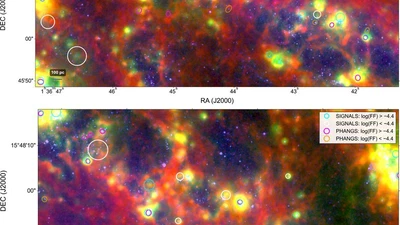
*Aims.* Understanding the internal structure of H II regions is fundamental to constraining star-formation processes in galaxies. We investigate how the *filling factor* (FF) …
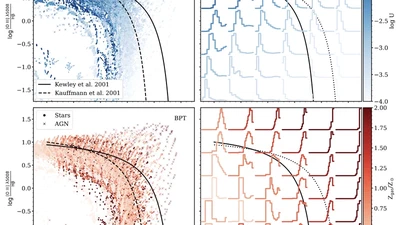
High-redshift observations from JWST indicate that optical strong line ratios do not carry the same constraining power as they do at low redshifts. Critically, this prevents a …
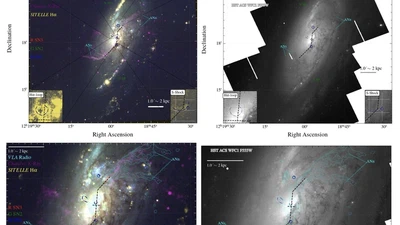
NGC 4258 is a prime target for studying feedback in Low-Luminosity Active Galactic Nuclei (LLAGNs) due to its proximity and comprehensive multi-wavelength coverage. Using new …
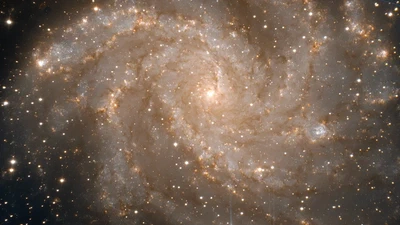
Using deep, narrowband imaging of the nearby peculiar spiral galaxy NGC 5474, we present stellar age information across its disk and offset bulge. As shown in earlier work on M101, …
As part of the SIGNALS survey, which comprises a sample of approximately 40 nearby galaxies observed with the Fourier transform spectrometer SITELLE, we present a study of metal …
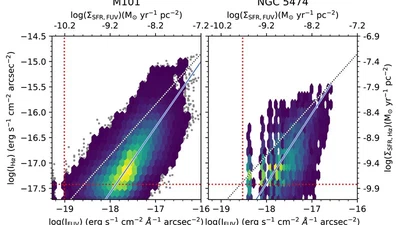
We examine the connection between diffuse ionized gas (DIG), H II regions, and field O and B stars in the nearby spiral M101 and its dwarf companion NGC 5474 using ultra-deep Hα …
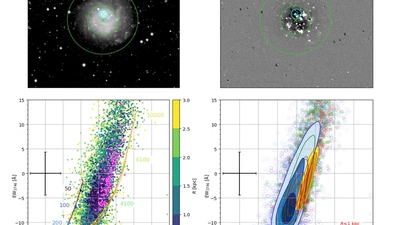
Stellar feedback is fundamental to the modeling of galaxy evolution, as it drives turbulence and outflows in galaxies. Understanding the timescales involved are critical for …