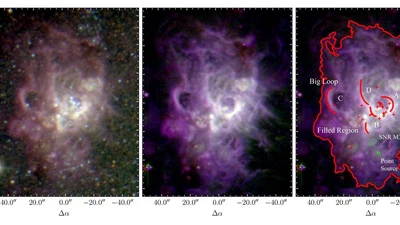
SIGNALS of Giant HII Regions: A Spatially Resolved Analysis of NGC 604
Observing giant H II regions at fine spatial scales uncovers detailed structures and reveals variations in ionization, abundance, and dynamical properties of ionized gas and the …

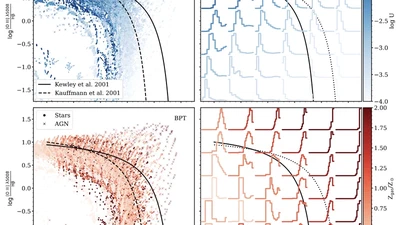
Optical Strong Line Ratios Cannot Distinguish Between Stellar Populations and Accreting Black Holes at High Ionization Parameters and Low Metallicities
High-redshift observations from JWST indicate that optical strong line ratios do not carry the same constraining power as they do at low redshifts. Critically, this prevents a …
nikko-j.-cleri
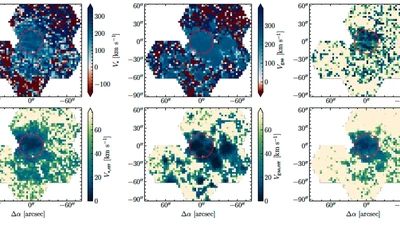
When Is a Bulge Not a Bulge? Revealing the Satellite Nature of NGC 5474's Bulge
A satellite galaxy of the nearby spiral M101, NGC 5474 has a prominent bulge offset from the kinematic center of the underlying star-forming disk that has gained attention in …
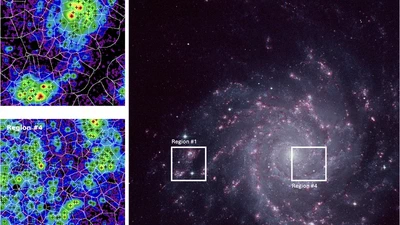
NGC 628 in SIGNALS: Explaining the Abundance-Ionization Correlation in HII Regions
The variations of oxygen abundance and ionization parameter in H II regions are usually thought to be the dominant factors that produced variations seen in observed emission line …
A Dynamic Galaxy: Stellar Age Patterns across the Disk of M101
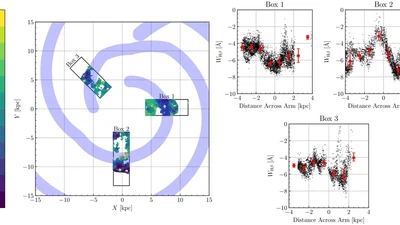
Using deep, narrowband imaging of the nearby spiral galaxy M101, we present stellar age information across the full extent of the disk of M101. Our narrowband filters measure …
Deep Narrowband Photometry of the M101 Group: Strong-line Abundances of 720 HII Regions
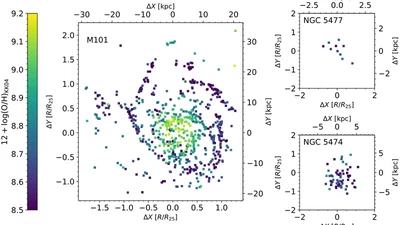
We present deep, narrowband imaging of the nearby spiral galaxy M101 and its satellites to analyze the oxygen abundances of their H II regions. Using Case Western Reserve …
Determining the Timescale over Which Stellar Feedback Drives Turbulence in the Interstellar Medium: A Study of Four Nearby Dwarf Irregular Galaxies
Stellar feedback is fundamental to the modeling of galaxy evolution, as it drives turbulence and outflows in galaxies. Understanding the timescales involved are critical for …
laura-hunter-congreve
A Deep Census of Outlying Star Formation in the M101 Group
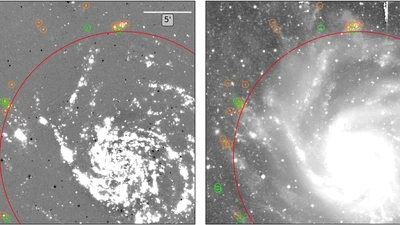
We present deep, narrowband imaging of the spiral galaxy M101 and its group environment to search for star-forming dwarf galaxies and outlying HII regions. We find no large …