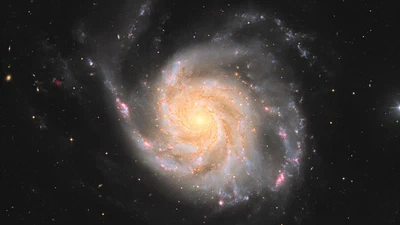
M101 Group: Galaxy Evolution in a Nearby Laboratory
I have focused on the M101 Group since graduate school. Because it is only a few megaparsecs away, this small, isolated galaxy group gives us a detailed look at how spiral galaxies …

I have focused on the M101 Group since graduate school. Because it is only a few megaparsecs away, this small, isolated galaxy group gives us a detailed look at how spiral galaxies …
We present deep, NIRSpec G140M and G395M spectroscopy of Little Red Dots (LRDs) at z = 6.68 and z = 8.35. Both LRDs show broad Balmer and [O III]λ4364 emission. The broad [O …
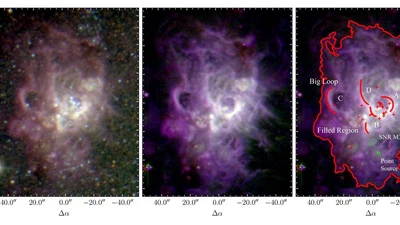
Observing giant H II regions at fine spatial scales uncovers detailed structures and reveals variations in ionization, abundance, and dynamical properties of ionized gas and the …
A 5-minute oral presentation delivered to the American Astronomical Society. This covers a recent completed paper on the spatially resolved data of NGC 604 as part of the SIGNALS …
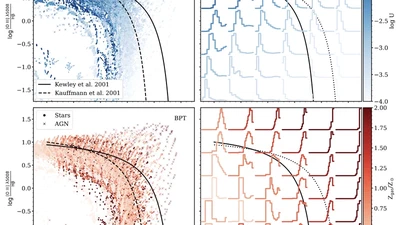
High-redshift observations from JWST indicate that optical strong line ratios do not carry the same constraining power as they do at low redshifts. Critically, this prevents a …
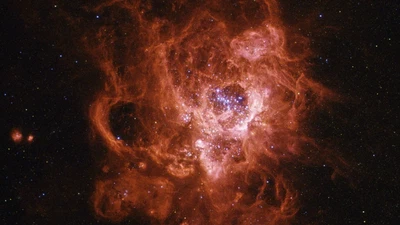
A poster presentation about my work investigating the spatially-resolved properties of NGC 604.
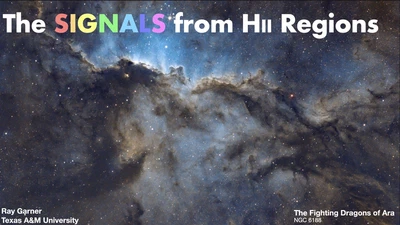
An invited review talk at the SIGNALS workshop about HII regions, pockets of gas ionized by hot stars. In this talk, I give an overview of the work that has been done about HII …
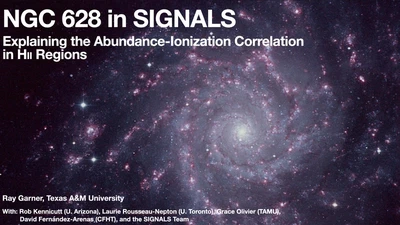
An invited presentation about my work investigating the correlation between the ionization parameter and oxygen abundance in NGC 628.
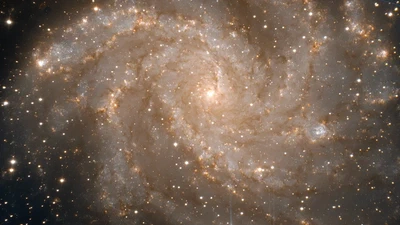
As part of the SIGNALS survey, which comprises a sample of approximately 40 nearby galaxies observed with the Fourier transform spectrometer SITELLE, we present a study of metal …
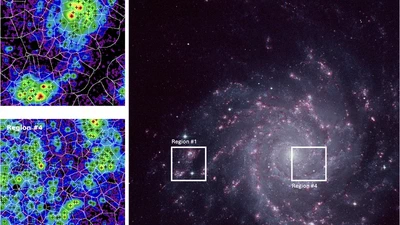
The variations of oxygen abundance and ionization parameter in H II regions are usually thought to be the dominant factors that produced variations seen in observed emission line …