Deep Narrowband Photometry of the M101 Group: Strong-line Abundances of 720 HII Regions
Dec 1, 2022· ,,,,·
0 min read
Ray Garner
J. Christopher Mihos
Paul Harding
Aaron E. Watkins
Stacy S. McGaugh
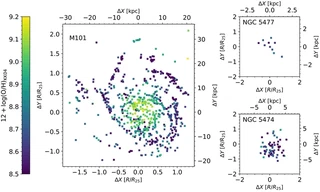 Figure 12 of Garner et al. (2022)
Abstract
We present deep, narrowband imaging of the nearby spiral galaxy M101 and its satellites to analyze the oxygen abundances of their H II regions. Using Case Western Reserve University’s Burrell Schmidt telescope, we add to the narrowband data set of the M101 Group, consisting of Hα, Hβ, and [O III] emission lines and the blue [O II]λ3727 emission line for the first time. This allows for complete spatial coverage of the oxygen abundance of the entire M101 Group. We used the strong-line ratio R23 to estimate oxygen abundances for the H II regions in our sample, utilizing three different calibration techniques to provide a baseline estimate of the oxygen abundances. This results in ∼650 H II regions for M101, 10 H II regions for NGC 5477, and ∼60 H II regions for NGC 5474, the largest sample for this Group to date. M101 shows a strong abundance gradient, while the satellite galaxies present little or no gradient. There is some evidence for a flattening of the gradient in M101 beyond R∼14 kpc. Additionally, M101 shows signs of azimuthal abundance variations to the west and southwest. The radial and azimuthal abundance variations in M101 are likely explained by an interaction it had with its most massive satellite, NGC 5474, ∼300 Myr ago combined with internal dynamical effects such as corotation.
Type
Publication
The Astrophysical Journal, 941(2), 182-201
Status
Peer-reviewed
Open access
License
CC-BY-4.0

Authors
Ray Garner
(he/him)
TAMU Astronomy Postdoctoral Researcher
I’m a scientist, Star Wars fan, and amateur photographer raised in Georgia. My research interests include galaxy evolution, star formation, and nebular diagnostics.