Optical Strong Line Ratios Cannot Distinguish Between Stellar Populations and Accreting Black Holes at High Ionization Parameters and Low Metallicities
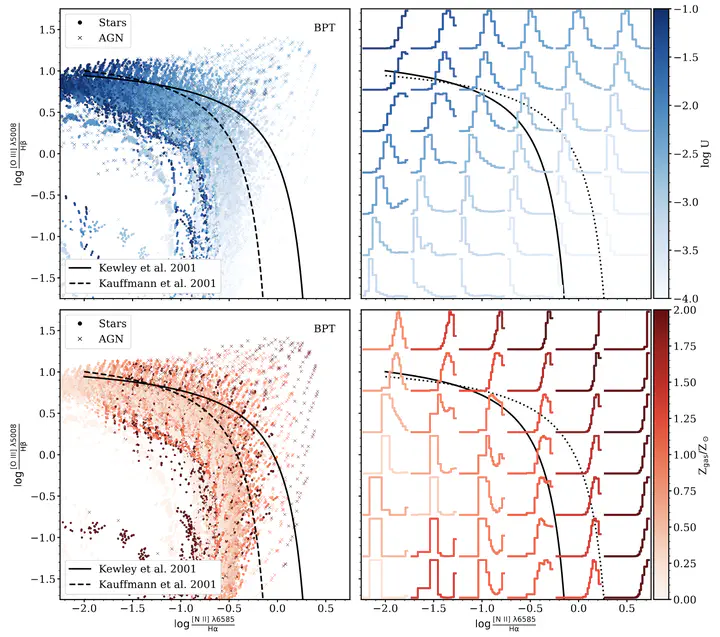 Figure 4 of Cleri et al. (2025).
Abstract
High-redshift observations from JWST indicate that optical strong line ratios do not carry the same constraining power as they do at low redshifts. Critically, this prevents a differentiation between stellar and black hole accretion-driven ionization, thereby obscuring both active galactic nuclei (AGN) demographics and star formation rates. To investigate this, we compute a large suite of photoionization models with Cloudy powered by stellar populations and accreting black holes over a large grid of ages, metallicities, initial mass functions, binarities, ionization parameters, densities, and black hole masses. We use these models to test three rest-frame optical diagnostics designed to separate ionizing sources at low redshifts: the [N II]-BPT, VO87, and OHNO diagrams. We show that these diagnostics are strongly driven by the ionization parameter (log U) and the gas-phase metallicity (Zgas), often more so than the ionizing spectrum itself; there is significant overlap between stellar population and accreting black hole models at high log U and low Zgas. The OHNO diagram is especially contaminated in the AGN region by stellar models with high log U and low Zgas, consistent with high-redshift observations. We show that the [N II]-BPT, VO87, or OHNO diagrams are most sensitive to the shape of the <54 eV ionizing continuum, an energy regime in which stellar populations and black hole accretion disk models can be highly degenerate. Finally, we discuss the potential for emission lines that trace the >54 eV ionizing continuum to differentiate between ionizing sources more effectively than the [N II]-BPT, VO87, or OHNO diagrams alone.

Ray Garner
TAMU Astronomy Postdoctoral Researcher
I’m a scientist, Star Wars fan, and amateur photographer raised in Georgia. My research interests include galaxy evolution, star formation, satellite galaxies, and nebular diagnostics.