Investigating the Galactic Evolution of M101 with Deep Narrowband Imaging
Oct 23, 2023· ·
0 min read
Ray Garner
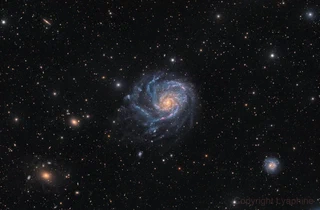 Image Credit: Lyaphine & Jens Unger
Abstract
How do galaxies evolve? This is at first a seemingly simple and fundamental question, yet it is a question laced with intricacies. To help unravel the mystery of galaxy evolution, I present deep narrowband imaging of the nearby spiral galaxy M101 and its satellites. Although the M101 Group is a relatively poor group with only one major member, it is a dynamic group! M101 itself is thought to have interacted with its most massive satellite ~300 Myr ago. Using narrowband images targeting key emission lines (Hα, Hβ, [O III]λλ4959,5007, and [O II]λ3727), I investigate how this interaction impacted these galaxies and their environment. I search for and find very little evidence of tidal debris in the form of outlying, intragroup H II regions, suggesting a weak or mild interaction. Turning to M101’s star-forming disk, I analyze the oxygen abundances and stellar ages of M101, finding a relatively ordered inner disk with an exponential metallicity gradient and stellar age gradient. Meanwhile, the outer disk is disordered, younger, and chemically enriched compared to theoretical predictions. I connect these features to both the tidal interaction and M101’s internal dynamics.
Date
Oct 23, 2023 2:30 PM — 3:30 PM
Location
Dunlap Institute for Astronomy & Astrophysics at the University of Toronto
50 St. George St, Toronto, Ontario M5S 3H4

Authors
Ray Garner
(he/him)
TAMU Astronomy Postdoctoral Researcher
I’m a scientist, Star Wars fan, and amateur photographer raised in Georgia. My research interests include galaxy evolution, star formation, and nebular diagnostics.