Poster: SIGNALS of Giant HII Regions: Resolved Ionization & Abundance Properties of NGC 604
Sep 15, 2025· ,,,,,,,,·
0 min read
Ray Garner
Rob Kennicutt
Laurent Drissen
Carmelle Robert
Laurie Rousseau-Nepton
Christophe Morisset
Philippe Amram
R. Pierre Martin
Emma Jarvis
 The HETDEX image of M101. Credit: G. Zeimann/HETDEX Collaboration.
Abstract
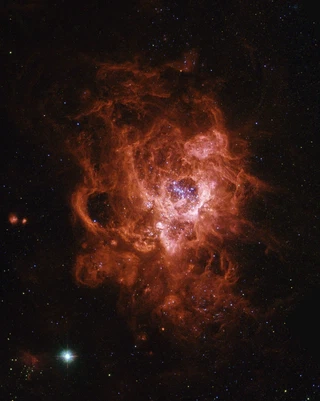
Although we often simplify them as such, real H II regions are not spherical ionized gas clouds with homogeneous physical properties. To study variations in chemical and ionization properties, high spatial resolution is required, which nearby giant H II regions satisfy well. Using emission line data of M33 observed with SITELLE as part of the Star-formation, Ionized Gas, and Nebular Abundances Legacy Survey (SIGNALS), we present maps of the principle optical emission line ratios for NGC 604, the most luminous H II region in M33. While much of the region falls within the low-density limit, the electron density map reveals clumps of higher-density material, suggesting that geometry may be a contributing factor. The excitation maps align well with the Hα morphology and are clearly related to the location of the central stellar cluster and secondary stellar groups. We note two distinct sources identified in these excitation maps: a known supernova remnant and an unknown point source. Maps of abundance- and ionization-sensitive line ratios show substantial variations across the face of NGC 604. We demonstrate that these variations are unlikely to be due to chemical inhomogeneities but instead are primarily caused by changes in ionization. Finally, we present the Hα kinematics of the region and connect it to the excitation structure. Throughout the paper, we make comparisons to and raise concerns about single-aperture and long-slit spectroscopic measurements of giant H II regions.
Date
Sep 15, 2025 1:00 PM — 5:00 PM
Location
Texas A&M University Memorial Student Center
275 Joe Routt Blvd, College Station, TX 77843
Conference Presentations
TAMU
Signals
IFTS
HII Regions
Abundances
NGC 604
Poster
Symposium
College Station
Texas

Authors
Ray Garner
(he/him)
TAMU Astronomy Postdoctoral Researcher
I’m a scientist, Star Wars fan, and amateur photographer raised in Georgia. My research interests include galaxy evolution, star formation, and nebular diagnostics.