The SIGNALS from HII Regions
May 20, 2025· ·
0 min read
Ray Garner
Abstract
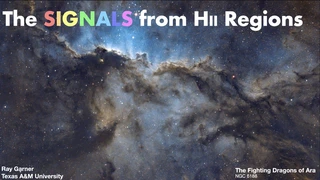
In this invited review, I present an overview of H II regions and their central role in our understanding of galactic ecosystems. I begin with a brief introduction to the fundamental physics of ionized nebulae, outlining the processes that govern emission line formation and structure. From there, I explore what we can learn observationally from H II regions, including how their emission lines allow us to diagnose ionization conditions and excitation mechanisms via diagnostic tools like the BPT diagram. I discuss the distribution of H II regions across this parameter space and the physical drivers behind their location on such diagrams. The talk then focuses on chemical abundance measurements and how these measurements trace the evolutionary history and current state of teh host galaxy. I conclude by highlighting several promising directions for future work within the SIGNALS collaboration, leveraging the unprecedented size and resolution of the dataset to address outstanding questions in star formation, feedback, and chemical enrichment.
Date
May 20, 2025 — May 23, 2025
Location
Université Laval
2375 De la Terrasse St, Québec City, Quebec G1V 0A6

Authors
Ray Garner
(he/him)
TAMU Astronomy Postdoctoral Researcher
I’m a scientist, Star Wars fan, and amateur photographer raised in Georgia. My research interests include galaxy evolution, star formation, and nebular diagnostics.