Explaining the Abundance-Ionization Correlation in HII Regions with NGC 628
May 20, 2025· ,,,,·
0 min read
Ray Garner
Rob Kennicutt
Laurie Rousseau-Nepton
Grace Olivier
David Fernández
Abstract
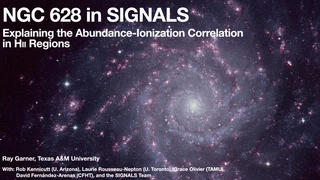
The variations of oxygen abundance and ionization parameter in H II regions are usually thought to be the dominant factors that produced variations seen in observed emission line spectra. However, if and how these two quantities are physically related is hotly debated in the literature. Using emission line data of NGC 628 observed with SITELLE as part of SIGNALS, we use a suite of photoionization models to constrain the abundance and ionization parameters for over 1500 H II regions throughout its disk. We measure an anticorrelation between these two properties, consistent with expectations, although with considerable scatter. Secondary trends with dust extinction and star formation potentially explain the large scatter observed. We raise concerns throughout regarding various modeling assumptions and their impact on the observed correlations presented in the literature.
Date
May 20, 2025 — May 23, 2025
Location
Université Laval
2375 De la Terrasse St, Québec City, Quebec G1V 0A6
Conference Presentations
TAMU
Signals
HII Regions
NGC 628
Abundances
Ionization Parameter
Modeling
IFTS
Laval
Conference
Quebec
Canada

Authors
Ray Garner
(he/him)
TAMU Astronomy Postdoctoral Researcher
I’m a scientist, Star Wars fan, and amateur photographer raised in Georgia. My research interests include galaxy evolution, star formation, and nebular diagnostics.