SIGNALS of Star Formation in Local Galaxies
Feb 10, 2025· ·
0 min read
Ray Garner
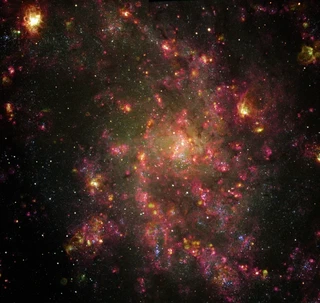 The core of M33 seen via SITELLE. Image Credit: L. Drissen
Abstract
H II regions, clouds of ionized gas and dust created by massive stars within young stellar clusters, serve as fundamental laboratories for understanding star formation and galaxy evolution. By analyzing their ionized gas properties, we can trace the conditions that shape stare formation across different galactic environments. The Star-formation, Ionized Gas, and Nebular Abundances Legacy Survey (SIGNALS) is investigating these processes by studying more than 50,000 H II regions across 35 nearby galaxies at an average spatial resolution of 20 pc. SIGNALS utilizes the imaging Fourier transform spectrograph SITELLE at the Canada-France-Hawaii Telescope to observe strong emission lines—[O II]λ3727, Hβ, [O III]λλ4959,5007, [N II]λλ6548,6584, Hα, and [S II]λλ6717,6731—allowing us to derive key physical properties of the ionized gas. In collaboration with the SIGNALS team, we are developing methods to systematically identify and analyze H II regions. In this presentation, I will highlight these techniques and showcase results for selected galaxies, including H II region populations, metallicity distributions, luminosity functions, and kinematic properties in diverse environments.
Date
Feb 10, 2025 3:10 PM — 4:00 PM
Event
CWRU Astronomy Seminar
Location
Sears Library @ Case Western Reserve University
2083 Martin Luther King Jr. Dr., Cleveland, Ohio 44106

Authors
Ray Garner
(he/him)
TAMU Astronomy Postdoctoral Researcher
I’m a scientist, Star Wars fan, and amateur photographer raised in Georgia. My research interests include galaxy evolution, star formation, and nebular diagnostics.